
Resident Rights
The best place to start with making sure your loved one is receiving the best care, is learning what you and your loved ones resident's rights are.
First, identify which license an assisted living home operates under.
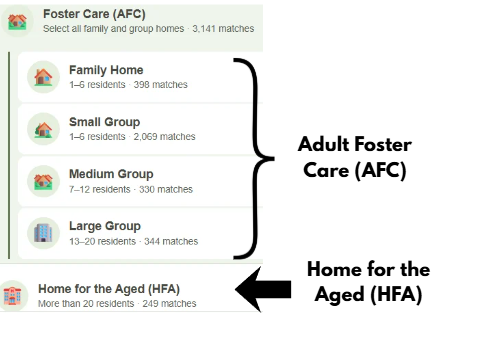
Adult Foster Care (AFC)
If the home falls under Adult Foster Care (AFC) - includes all Family Homes, Small, Medium, and Large Group Homes - click here to learn of your rights as a resident.
Home for The Aged
If the home falls under Home for the Aged (HFA) - click here to learn of your rights as a resident.
My Interpretation of the Rules
We’ve translated Michigan’s AFC resident rights into plain English to make them easier to understand. This information is for educational purposes only and is not legal advice. We encourage you to review the official Michigan rule for the complete legal language. Click the links above to see the rules as they are written by Michigan.
Home for the Aged (HFA)
MCL 333.20201(1) — The home must have and follow a resident-rights policy
The facility must have a written policy explaining resident rights and responsibilities, post it publicly, give it to staff, and treat residents according to that policy.
MCL 333.20201(2)(a) — You cannot be denied appropriate care because of who you are
The facility cannot deny you appropriate care because of your race, religion, color, national origin, sex, age, disability, marital status, sexual preference, or how your care is being paid for.
MCL 333.20201(2)(b) — You have the right to see or get a copy of your medical records
You can ask to inspect your medical record or receive a copy, although the facility may charge a reasonable fee. Your records generally cannot be given to someone else without your permission unless the law allows or requires it.
MCL 333.20201(2)(c) — Your personal and medical records must be kept confidential
Your personal and medical information should be kept private. You may generally refuse to have it released outside the facility unless disclosure is required or otherwise allowed by law, such as during a transfer.
MCL 333.20201(2)(d) — You have the right to privacy, dignity, and respect
You should be given as much privacy as reasonably possible during treatment and personal care, and you should be treated with consideration and respect for your dignity and individuality.
MCL 333.20201(2)(e) — You have the right to appropriate care and understandable information about your health
You are entitled to adequate and appropriate care. You should also be told about your medical condition, proposed treatment, and expected recovery in terms you can understand, unless a qualified healthcare professional has documented a medical reason not to provide that information.
MCL 333.20201(2)(f) — You can refuse treatment
You may refuse treatment to the extent allowed by law, and you should be told what could happen if you refuse. In some situations, if the facility can no longer safely or appropriately care for you because of that refusal, it may end the care relationship after giving reasonable notice.
MCL 333.20201(2)(g) — You can complain, recommend changes, and exercise your rights without retaliation
You can raise concerns, make complaints, or recommend changes to the facility, government officials, or another person of your choice. The facility cannot interfere with or punish you for exercising these rights. You are also entitled to know how the facility handles complaints.
MCL 333.20201(2)(h) — You can refuse experimental procedures
If an experimental procedure is proposed as part of your care, you have the right to be told about it and the right to say no without losing your continuing care.
MCL 333.20201(2)(i) — You have the right to understand your bill
You can receive and review an explanation of the charges for your care, regardless of who is paying. You may also request information about financial assistance offered through the facility.
MCL 333.20201(2)(j) — You have the right to know who is caring for you and what happens next
You should know who is responsible for your care and who is actually providing it. You are also entitled to information about your ongoing health needs, available options for meeting those needs, and to participate in discharge planning when appropriate.
MCL 333.20201(2)(k) — You have the right to private communication, mail, personal choices, religion, and community involvement
You may communicate privately with your healthcare professionals, attorney, family, friends, or anyone else you choose. You may send and receive unopened personal mail. Your civil and religious freedoms and ability to make personal choices should be respected, and you may participate in social, religious, and community groups unless a medical restriction has been properly documented.
MCL 333.20201(2)(l) — You have the right to be free from abuse and improper restraints
You must be protected from mental and physical abuse. Physical or chemical restraints generally cannot be used unless they are properly authorized for a limited purpose or are necessary during an emergency to prevent injury.
MCL 333.20201(2)(m) — You cannot be required to work for the facility unless it is part of your care plan
The facility cannot require you to perform services for it unless those services are included in your plan of care for a therapeutic reason.
MCL 333.20201(2)(n) — You have the right to know the facility's rules
You should be told about the facility's rules and regulations that affect your care or conduct.
MCL 333.20201(2)(o) — You have the right to appropriate pain and symptom management
Appropriate management of pain and other symptoms is considered an essential part of medical treatment.
++Additional Rights Specifically Applicable to Homes for the Aged++
MCL 333.20201(3)(a) — You must receive these rights when you move in
A Home for the Aged must give you its resident-rights policy when you are admitted, and staff must be trained to follow it.
MCL 333.20201(3)(b) — Married residents have the right to privacy with their spouse
If you are married, you are entitled to meet privately with your spouse in a room that provides privacy. If both spouses live in the same facility, they are generally entitled to share a room unless there is a documented medical reason they should not.
MCL 333.20201(3)(c) — You can keep and use your personal belongings
You may keep and use your own clothing and possessions as space allows, unless doing so would interfere with another resident's rights or there is a documented medical reason restricting an item.
MCL 333.20201(3)(d) — You can participate in planning your medical treatment
You should have the opportunity to be involved in planning your medical treatment and care.
MCL 333.20201(3)(e) — The home cannot discharge or transfer you for just any reason
A Home for the Aged may generally transfer or discharge you only for medical reasons, for your welfare or the welfare of other residents, or because you have not paid for your stay, subject to other applicable laws. You must also receive reasonable advance notice so the move can happen in an orderly way.
MCL 333.20201(6) — You must be informed of your rights before or when you move in
You must be fully informed of the facility's resident-rights policy before or at admission and during your stay. The facility should have written acknowledgment showing that this information was provided. If a resident has been legally determined to lack capacity and that capacity has not been restored, the statute also provides a way for another designated person to exercise certain rights and responsibilities on the resident's behalf.
MCL 333.20201(7) — The facility can give residents additional rights
These are minimum protections. A facility is allowed to create additional resident rights beyond what Michigan law requires.
Adult Foster Care (AFC)
R 400.681(1) — You have the right to be treated with dignity and kept safe
You should be treated with respect, protected from exploitation, and kept safe while living in the home.
R 400.681(2) — Any work you do should fit your care plan
If you do chores or other work in the home, it should be consistent with your assessment plan and abilities.
R 400.681(3)(a) — You have the right to be treated equally
The home cannot discriminate against you because of your race, religion, color, national origin, sex, gender identity, age, disability, marital status, or how your care is being paid for.
R 400.681(3)(b) — You keep your constitutional rights
Living in an AFC home does not mean giving up rights like voting, practicing your religion, moving around freely, or spending time with people you choose.
R 400.681(3)(c) — You can choose whether to participate in religion
You may attend religious services or activities if you want to, but you cannot be forced to participate.
R 400.681(3)(d) — You have the right to private mail
You may write, send, and receive your own mail. The home should not open or censor it.
R 400.681(3)(e) — You have the right to private phone calls
You should have reasonable access to a telephone and be able to have private conversations. You may be responsible for the cost of long-distance calls.
R 400.681(3)(f) — You have the right to make a complaint
You can bring concerns or complaints directly to the person who owns or runs the home.
R 400.681(3)(g) — You can speak up without being punished
You may complain, suggest changes, or raise concerns about rules or services without fear of retaliation.
R 400.681(3)(h) — You can talk privately with people you choose
You have the right to privately communicate with your doctor, attorney, family, friends, advocates, or anyone else you choose.
R 400.681(3)(i) — You can participate in social and community activities
You may take part in social groups, community events, clubs, outings, and other activities you choose.
R 400.681(3)(j) — You can use advocacy and community services
You may contact advocacy organizations or use community services if you want help, support, or advice.
R 400.681(3)(k) — You have access to your clothes and belongings
You should have reasonable access to and use of your personal clothing and possessions.
R 400.681(3)(l) — You have the right to visitors
You may receive visitors at reasonable times. If the home restricts visitors, those restrictions should be included in your assessment plan. Special consideration should also be given to visitors traveling from far away or working unusual hours.
R 400.681(3)(m) — You can choose your own healthcare professionals
You may choose the doctor, dentist, psychiatrist, or other healthcare professional you want to see.
R 400.681(3)(n) — You can refuse treatment, services, or medication
You have the right to say no to treatment, services, or medication. You should also be told about the possible consequences of refusing.
R 400.681(3)(o) — You can ask for help moving somewhere else
If you want or need to move to another living situation, you may ask the responsible agency for help relocating.
R 400.681(3)(p) — You have the right to privacy, dignity, and individuality
You should be treated like an individual person, with respect for your dignity, personal needs, and privacy.
R 400.681(3)(q) — You can access your own bedroom
You should be able to enter and use your bedroom at your own discretion.
R 400.681(3)(r) — Your records must be kept confidential
Your personal, medical, and care records should be kept private.
R 400.681(4) — The home must give you a copy of your rights
When you move into an AFC home, the home must give you or your designated representative a copy of these resident rights.